
February 2026 Newsletter
From the desk of Dr. Schoerning
Hey folks!
I am amazed by how much terrible stuff has happened since I last wrote you. The US left the Paris accords as well as withdrawing from a whole host of other UN programs. The endangerment finding that has allowed the EPA to regulate anything climate looks likely to be overturned. The resolution to allow mining of the Boundary Waters has passed the House and could be up for Senate vote any day. There’s more information about that at the bottom of this newsletter if threats to the Boundary Waters also make you wild with rage.
At this time, I think often that anger is an effective short term fuel, but love is what keeps us in the fight. I hope you’re keeping your strength up, and getting your hands in the earth when you can. Life is what we’re fighting for.
AR has been working to preserve access to climate information during this challenging time. But information access, while foundational, is not enough on its own. We need pathways to action. The most important work AR has done this December through February has been putting structures in place to support not just information preservation and transmission, but action on the ground.
Our members-only website launched on February 13th. This new member side was designed to preserve information, connect more directly with the AR community, and mitigate our reliance on third-party platforms. If you're not already a member and want to be part of this growing space, you can check out membership options on our website. (Members, this is a little reminder that my next office hours are scheduled for Thursday 2/26/26 at 2pm Central. Feel free to drop in & out of this regular, live, casual Q&A.)
We are also launching the renewal of our ground volunteer program in March. Michael has joined our staff team to lead that program. Now more than ever, we need resilience action on the ground. We are in a narrow window between 1.5 and 2C, the window that has been identified as critical for resilience and adaptation work, and no one is coming to save us. In a reality where “leadership” is largely engaged in high-level looting, we have to make the changes we want to see. Our volunteer program will help participants develop community organizing skills, then put AR's action-oriented approach to work on specific local goals, centered around resilience building on food systems, water systems, and community connectedness. If we can build resilience into those basic systems in our communities on the ground, we’ll be better able to respond to stress in these challenging times, no matter what threats emerge.
Here’s the AR content I think is most important from this past quarter:
Water Organizing & Action
This video dropped to the public on February 12th and contains some of the most practically useful information AR has produced around water protection. I interview my colleague Tara-Sky Woodward, who shares concrete guidance on cultivating intentional community around water issues. We walk through a critical toolkit for anyone seeking effective legal action: proactive zoning and community benefit structures. If water is a concern for your community, this one is essential viewing.
January ‘26 Earth Systems Update
This one gets into the complexity. There is a trend in the averages heading more towards normal, which is positive—the alternative of a continued steady march to 2C and beyond certainly seems worse than the mild dip we’ve observed below 1.5C, with 2025 coming in at 1.47C. However, that average conceals some alarmingly large anomalies. I explore land, sea, and ice observations to help us understand the intensity of these anomaly temperature patterns, with particular attention to the strongest ocean current in the world: the ACC, Antarctic Circumpolar Current. I think it’s time to go beyond AMOC, the Atlantic Meridional Overturning Circulation, if we want to really get the picture of what’s happening here.
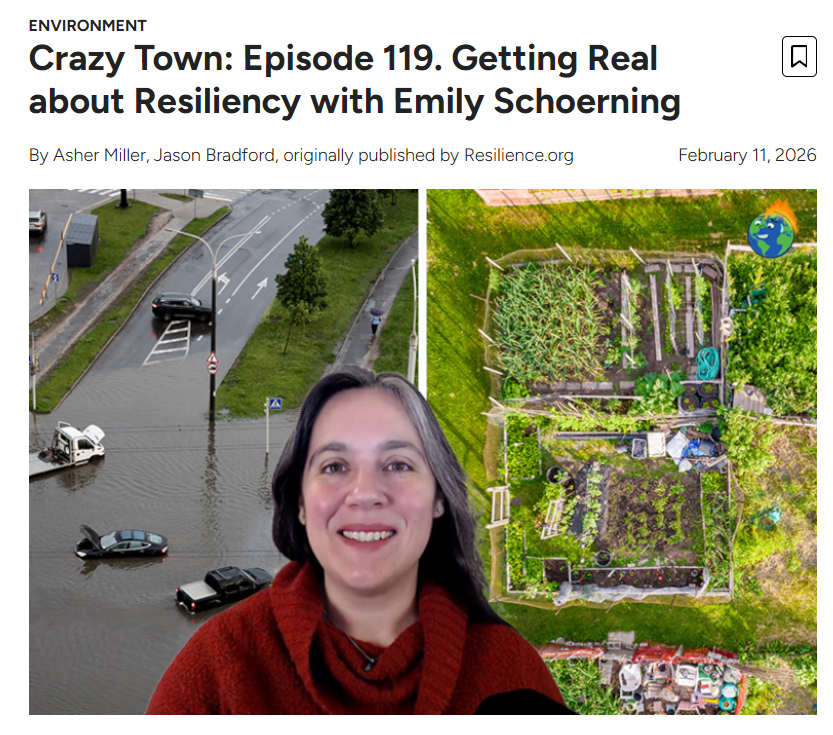
Collab: Crazy Town Podcast
I was honored to be interviewed on this podcast. That team puts serious work into their research and narrative structure, and they covered an impressive range of topics. I've respected the Post Carbon Institute's work for years, and I'm glad to be beginning regular collaboration with them. Going forward, these newsletters will be published on their website as a quarterly feature as we work toward our shared goals of promoting action and knowledge around climate and resilience.
Learn more about Crazy Town and the Post Carbon Institute here:
AR runs on the support of this community. If you've found this work useful and have the capacity to contribute, becoming a member or making a donation directly funds our ability to keep producing content, launch new programs, and build the infrastructure that keeps this information accessible. Every contribution—large or small—is what makes this work possible.
Wishing you all the best,
Emily
& If you love the Boundary Waters:
Check out savetheboundarywaters.org.
The team there is tracking HB 140 and organizing opposition. The proposed damage to the Mississippi headwaters would have major, generational impacts on the resilience potential of the entire watershed.