
VIDEOS
Use the categories below to navigate through our videos.
Find more on our YouTube channel!
Use the categories below to navigate through our videos.
Find more on our YouTube channel!
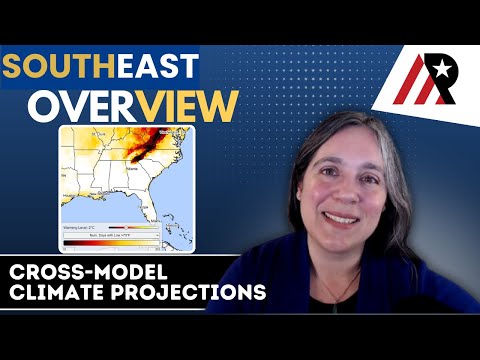
This cross-model regional overview is part of a series and focuses on the Southeast. The NCA5 defines this region, our primary source material, as including: Arkansas, Louisiana, Tennessee, Mississippi, Alabama, Florida, Georgia, North Carolina, South Carolina, Kentucky, West Virginia, and Virginia.

Southern Great Plains, which includes Texas, Oklahoma, and Kansas. In this video, we focus on the big edges of the problem. Major high-end heat increases, and a serious drought trend over much of the region. This is a region of extremes, with tough people who handle adversity well.
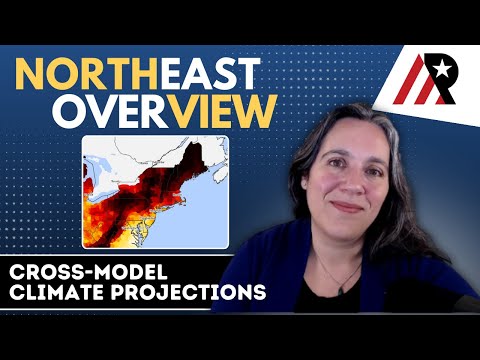
This cross-model regional overview is part of a series and focuses on the Northeast: Connecticut, Delaware, Maine, Maryland, Massachusetts, New Hampshire, New Jersey, New York, Pennsylvania, Rhode Island, Vermont, and West Virginia.

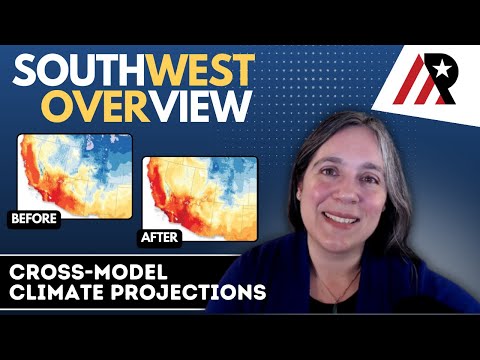
Arizona, California, Colorado, Nevada, New Mexico, and Utah.
Here, we consider big picture projections for water stability and heat increases across the region, as well as what to expect with our best current understanding of tipping points.
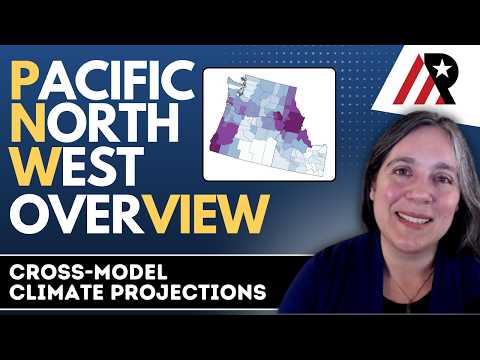
Washington, Oregon, and Idaho.
Here we consider big picture projections around water cycle changes and their landscape implications, as well as what to expect with our best current understanding of tipping points
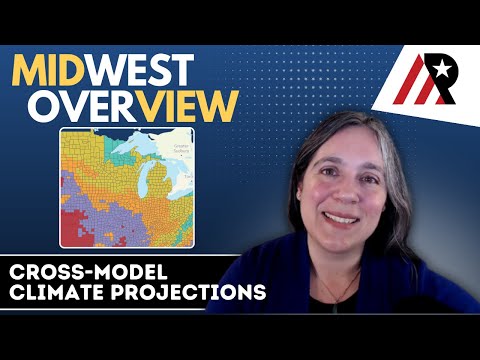
Midwest Overview: Ohio, Indiana, Illinois, Michigan, Missouri, Iowa, Minnesota, and Wisconsin.

Dr. Emily takes a look at the drought map as we consider wildfire risk, then compares two wildfire risk tools.

Folks, it's time for an earth systems health check, and I don't like what I see. You know I don't like freaking people out, but it's important to keep our eyes open, and I think there's stuff worth looking at as you think about how you want to spend your time. Particularly as we investigate a viewer question about the North Pacific Gyre. Have you heard of that? I hadn't. Let's take a look.

For the past about 16 months, Antarctica has been getting real freaky. Might be a bit beyond weird.

We've got some serious challenges building in parts of South Carolina, and potential opportunities emerging in others.

A brief overview of damaging earthquake frequency across the US, as well as a map of both active and shut down nuclear sites.

Kentucky is looking at both challenges and potential opportunities in these projections, and the state's responsible care of water and diversified economy are added strengths worth considering.


This outlook for Delaware is extremely difficult, with major implications for regional transportation.

These projections for Rhode Island show great cool summer preservation, but we are looking at a significant landscape transformation due to the major loss of winter cold duration and intensity.

Canada Update: This is different from our other videos, it's looser and more extrapolative.

Shocker- Mississippi looks hot!
The projections are showing greater increases in heat duration than heat intensity. And excellent potential for landscape stability in large parts of this state. There is some fascinating resilience potential in the ancient landscapes of this beautiful state.

Dr. Emily shares both the challenges and the opportunities facing all our friends in Missouri.

You won't be shocked that Vegas is projected to pick up a lot more days over 105 by 2C, but Dr. E was very interested in the relative stability she found in other parts of the state.
For those watching solar field developments, it's worth noting there are major signs for deluge-type rain emerging over Tonopah.

Dr. Emily shares what we know about where to expect extreme rain, even if that doesn't tell us how much.

Oklahoma: a challenging outlook for a state already accustomed to challenging conditions.

International Outlook featuring Uganda. If you’re interested in climate & food, this is an important one. Dr. Emily shares information on the country’s climate outlook based on projections from the World Bank.

Kansas is looking at some challenging heat increases in these projections, but this may be an outlook within adaptation range.

Arkansas. 105+ heat, seriously increased wildfire risks, and deluge signals.

Nebraska outlook, plus the regional and economic stability that we can visualize more clearly now that we can see where and how Nebraska is in play.
If you're interested in food systems and you haven't considered Omaha's role in our present and our 2C future, this is a state-level outlook worth studying.

This video is useful for putting a frame around your resilience prep. An aircraft hangar full of freeze-dried food will not help you comfort a crying child, make dried foods not taste gross, or properly put on a tourniquet.

A look at November ‘24 Earth systems information, talk about modeling for near-term AMOC collapse impacts, do a 2C big picture overview for the US and Canada, and talk about how these colliding models are likely to interact.

Dr. Emily teaches how to ID disease-carrying mosquitoes that are moving into new habitats, as well as how to recognize diseases they carry.

There are some parts of Europe with fairly good cross-model stability, but the overall picture for the EU and the UK is much more difficult than we see projected for North America.

For your viewing pleasure, a boring video about the most boring places in the US. They look boring in so many ways, under so many scenarios.

Learn with Ash, a major innovator in resilience-focused architecture, including the use of earth-based materials.

This video focuses on the value of play for building resilience. Most people who are climate aware navigate complex emotions, and sometimes the depth of our grief can make it difficult to experience happiness or pleasure. But we need to cultivate those capacities to make it through hard times. Play matters!
Featuring AR Volunteer JP.

This is part 2 of Ash's teaching on building heat resilience. Ash is a professional architect with an interest in climate resilience and the built environment.

Learn from Ash, a working architect with a professional interest in climate resilience and the built environment. In Part 1, we focus on solutions to help keep you cool in the event of a utility failure, with ideas that work in both arid and humid climates.

Dr. Emily shares information about our ground launch, with a focus on helping you build resilience in your community.

This video follows up on our coverage of hurricanes Milton and Helene.


Flash Drought & Flood: Helene
This video brings us back to a big picture, putting the pieces together around continent-level trends happening now.

Dr. Emily presents evidence for tipping point indicators in Brazil.
Brazil has a fairly stable area in the cross-model projections- important info for people in Brazil.
The outlook for Brazil has important implications for global food systems.
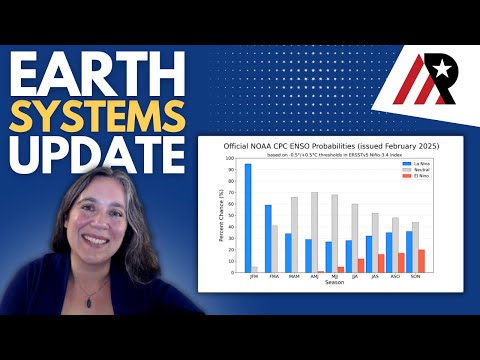
We are seeing signs the global temperature spike in '25 may have been similar to what we saw in '24.

Dr. Emily shares the projections for the Caribbean and the US Pacific Islands, including Puerto Rico and Hawaii.

In this video, Jackie Ryan takes us under the hood of her visualization of the NCA5 datasets.

Dr. Emily teaches you how to ID disease-carrying ticks that are moving into new habitats, as well as how to recognize diseases they carry.
This video shares the incredible worksheets and workshop that El, a disaster-preparedness professional, has designed and piloted with the AR community!

Learn from Ash, a working architect with a professional interest in climate resilience and the built environment. This teaching focuses on ways to make your home more resilient against hail and high-speed wind, with a review of where we expect these threats to worsen or emerge.

This is a complex video looking at the emerging threat of fire across the national landscape, as well as how we can find paths through the fire and look towards what comes next.

This is an important action step for people interested in trees that can survive these times of change.

Dr. Emily shares a slice of the talk she gave at ESF's Earth Week 2025, including detailed projection info, as well as ground notes from Rochester to Utica.

This video focuses on two resources recommended by a retired wildlands firefighter.

Dr. Emily interviews El, a professional in the disaster response and resilience space. El shares information from within the field about trends in the disaster response space and advice on practical actions and prep for this summer.

Dr. Emily looks at both the big picture positive signs and the potentially concerning signs emerging in Earth systems today.

Dr. Emily talks about what it means to want to be alive through this tipping point.

Ground report from Dr. Emily’s trip to the Bozeman area.

Dr. Emily speaks with Janna from Earth Friends, an educator with a focus on social-emotional learning and sustainability.

Just a quick update regarding an upcoming resource we're going to want to access: the NOAA Atlas 15
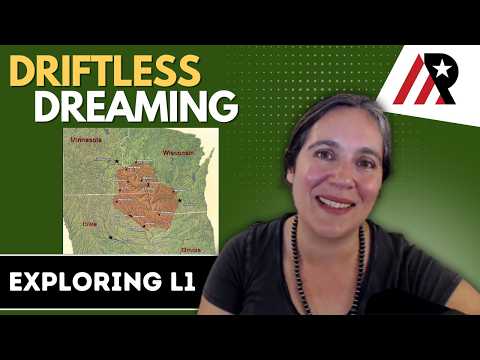
This video shares a little information about a special place in a resilient region.

In this video, we're looking at the national overview in both 2C and tipping point conditions- Alaska and Hawaii are included.

Dr. Emily shares the three top seed recommendations for climate resilience across the US- tepary bean, black cumin, and hazelnut- as well as other cool info from the Seed Savers' Exchange conference

There is strong, peer-reviewed evidence that we are seeing phase-change behavior in deep ocean systems.

In this video we'll take a look at the expanded coverage for real time flood info.

Because we all need to eat.

This ocean stuff is changing fast along multiple factors. Weird ocean behavior has been a leading indicator for change in other Earth Systems for years. A hard one- draws some threads together.
This video is the quick & dirty version- I'll get you more info on Wisconsin ground conditions and excellent nerdy resources in a more detailed video to come!

Many people are aware that without the warmth from the Gulf Stream, the UK would be looking at intense cold. The question is, how cold are we talking?

My local food bank is seeing overwhelming demand this November- is yours? In this video, we start with direct actions to address food resilience in our ground communities.

If you're a person who wants to live in a gigantic world-class city with good resilience potential, Chicago has been putting in the work since 2008.

This video offers practical advice for talking with people close to you about climate resilience.

First pass at an at-a-glance type climate risk map with info on how to interpret this figure and present its many limitations in this short video.

This international outlook video focuses on 2C modeling for Pakistan, India, and Bangladesh.

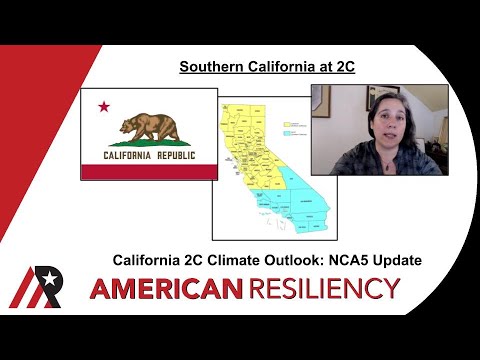
Southern California's outlook is quite serious for LA, Bakersfield, Blythe, Imperial, and other inland communities.
There are layers of challenge here, including very severe heat increases, drought trend, and more intense, more irregular atmospheric rivers. We also see a very intense hot spot for deluge-like precipitation appear over Bakersfield.

In Northern California, we find potential for building long-term resilience. This region begins south of the Bay Area at about Half Moon Bay, extends to the eastern edge of about Napa, and returns to hug the coast all the way up to Eureka.
We've got some serious challenges building in parts of South Carolina, and potential opportunities emerging in others.

The NCA5 projections give us some meaningful new information for Tennessee. We see some improvement in the outlook for the higher-elevation parts of the state, and we've got a clearer picture of the hot-season extension facing the west.


Here we walk through the climate projections on a wide range of factors for New Hampshire, which present both challenges and opportunities for this state.

Projections for Vermont's climate at 2C, plus resources to learn more about location-specific flooding risks and important work going on in Vermont to strengthen local food systems.

There is a push to get everyone freaked out about climate and crop failure. And we are seeing crop failure. But why isn't it touching commodities prices?

Inland, Massachusetts has pretty solid climate preservation in the projections and great resilience potential. But by and large, it's looking pretty rough along the coast, especially around greater Boston. This video also identifies emerging serious flooding risks associated with the Merrimack River watershed.

Interesting information on national and regional grid reliability from the AR community. If you are in the know, you can predict demand related power outages several hours in advance.

Even in high-end sea level rise scenarios, Connecticut still looks super cute. The biggest change for this state looks like it will come to the winters.

The derecho that passed through the Midwest in July 2024 was bad news. Storms like that are becoming more common. They're always scary, but with some basic prep, you and your family can feel calmer, safer, and more prepared in the event of a short term power outage. This unintimidating video is useful for families on a budget.

Sea level rise is the biggest challenge facing New Jersey, by a long shot. And the worst part is, it won't take extreme scenarios to mess up this state in a big way. In this video, we look at the most vulnerable areas first, then check out the other change factors projected for New Jersey, which are not too bad.

In the NCA5 we see a much larger change in the projections for Utah than other states in the region. In this video, we investigate the ominous high-change blob centered over Utah in the updated national climate assessment, and present the tipping point type risks unfolding around the Great Salt Lake.

A look at the June 2024 earth systems update from the Copernicus Institute.

Wyoming's outlook is improved in the NCA5 from the NCA4. In the NCA4 we saw real threats to Wyoming's mountains, but in these updated figures, we have more hope for some stability in this critical headwaters area. Don't get too comfy though- this state looks to remain pretty darn wild!

No one should be surprised that Texas is looking rough at 2C. If you're planning on building resilience in Texas, you need to know what you'll be up against. You're facing some of the most extreme and complex challenges in the entire nation.

Pennsylvania is looking pretty solid in these projections. Except for the greater Philadelphia area, you're looking relatively low change. And, while Philadelphia is going to be impacted by sea level rise, it's looking way less trashed than the other major northeast coastal cities.

Montana, you are not looking too bad here. There are some challenges ahead, but there's also a good edge to hold on the ag side, and your major population centers are looking quite stable. We identify your areas where the fire danger is increasing the most, and give you some key resilience action areas for different parts of the state.

North Dakota, sometimes it makes me sad to do the research for these outlooks, but your outlook just gets better and better the more pieces we put together. North Dakota is a rising star, a real jewel in my personal favorite part of our nation. If you like eating food, you ought to enjoy this outlook.

In the NCA5 outlook for Oregon we issue our first battle cry, recognizing those who choose to fight for the soil of the Willamette Valley. Their work will matter to us all, as the information we can gather from the NCA5 shows Oregon facing an extraordinary level of change. Only the work we do on the ground can protect Oregon's precious soil. If the soil of Oregon is allowed to be exposed and uncared for during the rapid landscape transformation ahead, we could see a terrible dust bowl emerge.

Illinois is an urban and an agricultural powerhouse, and we're facing some pretty serious challenges as we look towards 2C, especially south of Peoria. Throughout the state we're seeing fairly large projected heat increases, particularly in nighttime heat. In specific locations, we've got pretty serious signals for dangerous floods.

We are using the publicly available datasets in new ways to help us build resilience. We are showing that the AR community has what it takes!

We are moving into a time where we should expect less certainty. Dr. Emily talks about AR's response to the changes that are happening now.
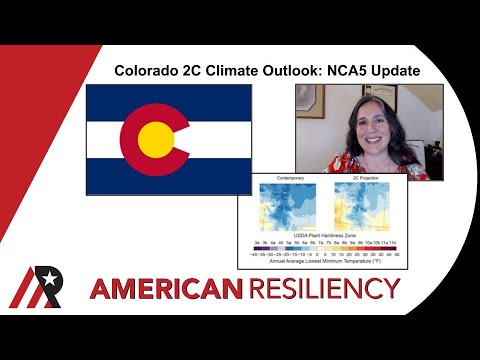
Colorado, you've got a heck of a lot going for you in this outlook. Great outlook for the whole Front Range, Grand Junction is looking nice, most challenging conditions are in the southeast corner of the eastern plains. And you're gonna want to look at the relative stability of your mountain winters- we compare your mountain outlook to other western states. You are looking so strong.

There's still an edge to hold in Maine. But these winter projections are worse than they were in the NCA4. Dr. Emily gives you the straight talk in this outlook, which is heavy on local details & suggested areas for action.

Maryland, you've got an interestingly varied outlook here. To the west, you look awesome. Towards the bay, you're dealing with some extremely serious sea level rise issues. Check it out, we'll walk through projected changes to seasonal temps, precipitation, and more, and help you identify risks and actions to take in your area.

New York state, this is the wildest outlook in the nation. Definitely the most variation, for better and for worse. We've got a lot of folks in the AR community in New York state, so we've got details on a TON of places in this outlook.

Alabama, you're looking at some challenges, but there's a lot of potential to build resilience in this state. And, you've got the most interesting sea level rise impacts in the country, with some surprisingly stable emerging coastline. Get details on the challenges in this video, including locations that are likely to experience big increases in warm nights and deluge-type rains, as well as emerging opportunities north of Mobile.

Virginia, you've got a solid overall outlook here. To the west, you look awesome. Towards the coast, you're going to be looking at some significant warming, as well as some serious sea level rise issues. Check it out, we'll walk through projected changes to seasonal temps, precipitation, and more, and help you identify risks and actions to take in your area.

Finding out projected local days over 95 is a big PITA- needs three separate visualizations in the NCA5. Thanks to a volunteer, we now have the information available in one great resource!

Lots of details here for the greater Phoenix area, Tucson, and Flagstaff. Bottom line: we're looking at an almost 3 month extension of days over 95 in the cities of southern Arizona, with a full month of that over 105.

Minnesota has an interestingly varied climate outlook, with regions of high change and regions of wonderful stability. Let's walk through the state, we'll identify challenges and opportunities for the distinct regions forming up in this state-level outlook.

We haven't taken a good look at the projections for increased days over 105 as we get ready for 2C. Let me show you what I figured out, and you can look for yourself here:
https://atlas.globalchange.gov/#exploreshorts
Open the explorer, and from in the explorer, choose the "open map" button towards the bottom of the screen.

The NCA5 outlook for Idaho is high-change, but in your most populated areas you do show some serious potential for resilience building. Dr. Emily walks you through the projected changes to seasons, precipitation, snowpack, and fire risk.

Wisconsin is looking about as good as it gets in the projections for 2C. Check it out, there's good info on where to expect challenges like extreme storms and wildfire, and where Dr. Emily thinks Wisconsin's got the potential for healthy growth and generational opportunity.

This outlook is hard, but it's got more of an edge to hold for Louisiana than we saw in the NCA4. In this video Dr. Emily checks out projections for heat, precipitation, ag output, sea level rise, and costs for the energy transition.

The NCA5 outlook for Washington state is very different from what we saw in the NCA4. In this video we learn new information that will help communities build resilience in eastern Washington, which remains very strong, and we identify important emerging challenges in western Washington, along with response actions.
Ohio is projected to shift away from a Midwestern and towards a classic Southern climate- that's a big change! Ohio is high change, but it's also high capacity. This video takes a realistic look at the challenges and opportunities facing Ohio as we approach 2050.
Video published 1/18/2024

Indiana, you can't hide your solid climate outlook and your first in the nation infrastructure work.
Video published 2/8/2024

Check out Iowa's super solid outlook for 2050. There are few areas where outlooks have improved in the NCA5, this right here is one. If you are concerned about food security, this good news for Iowa is good news for you.
Video published 12/14/2023
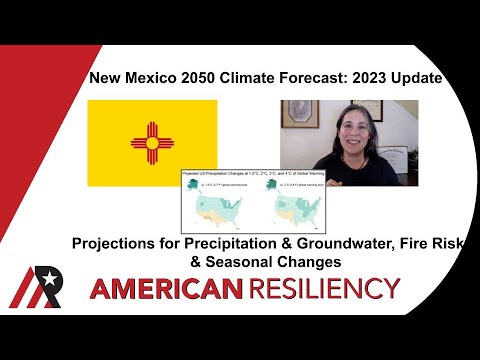
New Mexico's climate outlook is challenging- no surprise- but there's a real edge of hope emerging in Northern New Mexico. Check out the details in this video.
Video published 1/11/2024

The new projections for Michigan are showing some real differences from the last report. This video contains detailed information about changes to the winters, where we expect to see the biggest storms, and the projected increased risks around serious wildfire. The challenges are serious, but I would not count Michigan out. People looking for a destination with mild winters should check out this unexpected outlook.
Video published 12/28/2023

Dr. Emily digs deeper into recent publication on groundwater levels across the US.

Big thanks to Dr. Muhammad Ittefaq @ScienceTalkOfficial for this interview. For those of us working to grow our understanding, it is important to understand not only our domestic outlook, but also global impacts and outlooks. In South Asia, there is no debate. 1.5C impacts are unfolding as expected.

In this video we're going to do a bit more than check on incoming Earth systems info, Dr. Emily is going to try to help increase our understanding of ocean systems.

Move from reality into imagining, looking at some of the ways our culture is processing this climate reality, and imagining our climate future, through the arts.

Want info on how to get organized and get moving around water and data center issues? This video delivers!

In this outlook as you will see, Japan is looking good. Dr. Emily works to present this fairly positive outlook in the context of serious changes to the ocean, which will likely seriously impacts Japan's food systems.

In this video we look at Central America, broadly defined from the Yucatan to the northwestern edge of Columbia.
Central America is the final region where projections indicate critical tipping point indicators can be found.

Dr. Emily talks with David B, a water specialist with extensive international experience around water and peacebuilding.